
Cash · For parents
4 min read · 27 October 2026
A free pocket money chart for four weekly check-ins
Cash the Builder helps you look back four times: what came in, what went out and what is still yours? With a free printable and one savings goal.
Save to Pinterest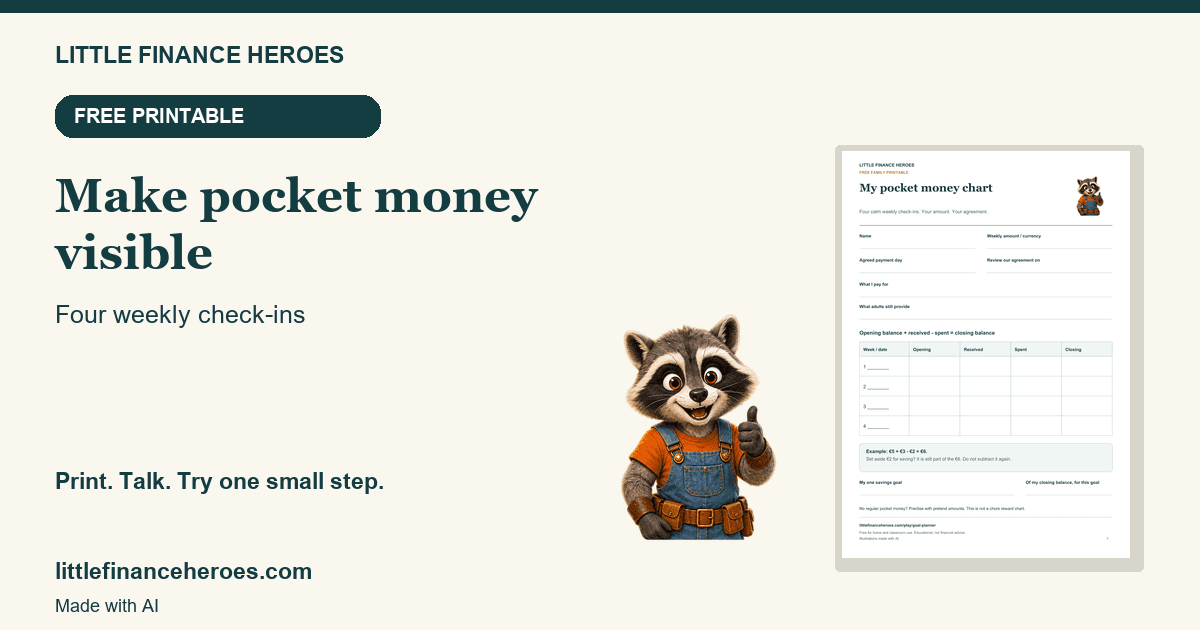
📄 Download the free pocket money chart:four weekly rows, space for your own agreement and one savings goal.
A pocket money chart should make the next conversation easier. It does not need a complicated reward system or a long list of chores. This free Little Finance Heroes printable gives you four weekly check-ins, space for your own agreement and one small savings goal. Cash the Builder helps you ask a useful question: what came in, what went out and what is still yours?
Agree the purpose before the amount
Start with what your child may choose to buy and what adults will continue to provide. Write it down in plain language. For example, a family might use pocket money for optional treats, while adults remain responsible for meals and essential clothing. That is an example, not a rule for every home. MoneyHelper says there is no single right pocket-money amount; affordability and circumstances matter.
Choose an amount and a regular review day that your household can manage. The chart does not print an age-based payment table, because a worksheet should not decide your budget. If regular pocket money is not possible, practise the same activity with pretend tokens or an occasional amount already available. You can have a useful money conversation without promising extra spending.
How to fill in the weekly chart
Write the date and the opening balance first. Add money actually received during that week. Record money actually spent, then calculate the closing balance: opening money plus money in, minus money out. Start the next row with that closing amount. Counting a jar together is one option; checking an agreed balance with an adult is another. The printable is a handwritten learning record, not a bank account or a payment app.
An example that keeps the maths clear
Suppose a child starts with €5, receives €3 and spends €2. The closing balance is €6. The child decides that €2 of that €6 is for a goal. Moving it into a savings jar does not mean it has been spent. It is still part of the €6 total. The goal box records the choice without subtracting the same money twice. These are invented teaching amounts, not a suggested allowance or product price.
Keep saving and spending choices visible
Ask your child to choose one goal and write why it matters. Leave space for a small purchase they enjoyed as well. Try asking, 'Would you make the same choice again?' rather than grading the answer. If there was an unexpected purchase, check the arithmetic together and make the next plan from the real balance. Avoid turning every ordinary family contribution into a paid task unless that is a separate agreement you have deliberately made.
Use it with different learners
For a younger child, read the headings aloud and let them draw their goal. For a confident calculator, ask them to explain how one row connects to the next. In a classroom, give everyone the same fictional starting balance. Never ask pupils to announce their real pocket money or compare which family pays more. Work in pairs, then discuss two different choices using the same imaginary amounts.
Turn one choice into a plan
When a child has chosen a goal, open the free Goal Planner. Enter a target, what is already saved and a realistic weekly contribution. Compare that plan with the money actually available on the chart. The printable records weekly choices; the tool helps organise a goal. Neither requires you to buy a paid workbook. Print a fresh chart when these four rows are full. This resource is educational, not financial advice. Illustrations made with AI.