
Goldie · For parents
4 min read · 27 October 2026
Money conversations with kids by age: five to twelve
One honest question and a small shared activity can be enough to begin. Goldie helps you choose a starting point for ages five to twelve.
Save to Pinterest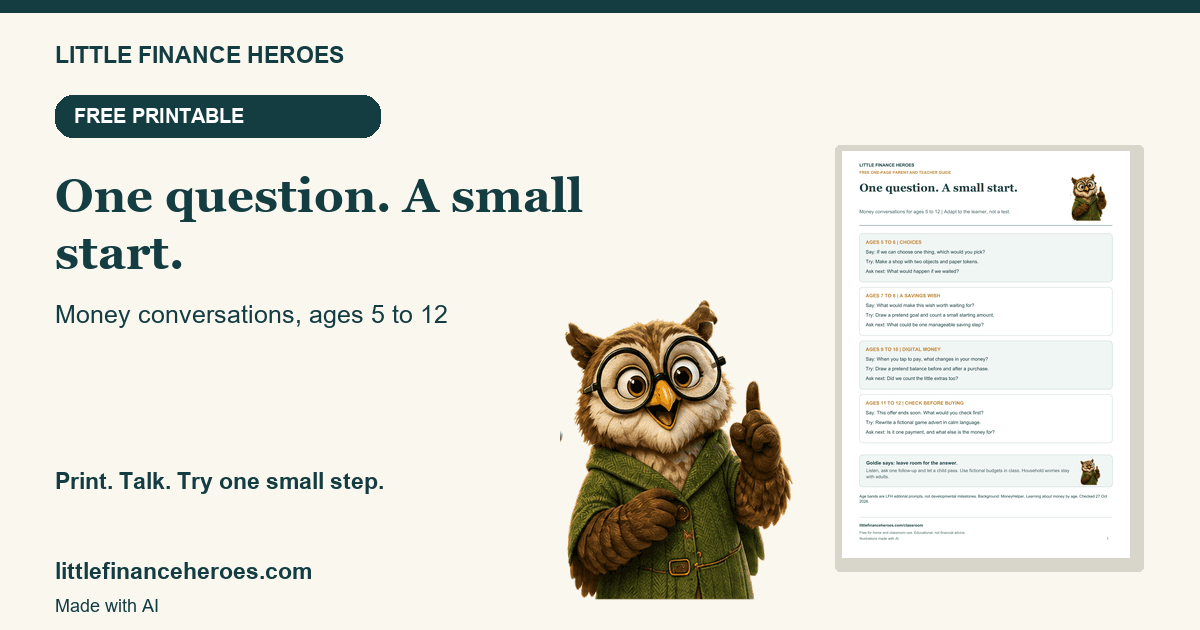
📄 Download the free guide:one A4 page of ready-to-say questions and quick activities for ages 5 to 12.
You do not need a finance lecture ready when a child asks why something costs money. One honest question and a small shared activity can be enough to begin. This free Little Finance Heroes guide to money conversations with kids by age fits on one A4 page. Goldie helps parents and teachers choose a starting point for ages five to twelve, with a phrase to try, an activity and a follow-up question.
Use age as a starting point
Children do not all read, calculate or feel comfortable with money at the same pace. MoneyHelper's age guide adapts topics as children grow. Our four bands, 5 to 6, 7 to 8, 9 to 10 and 11 to 12, are editorial groupings for this printable, not a developmental test. Choose an easier or more complex activity whenever it suits your learner.
Ages five to six: what is the choice?
Try saying, 'If our pretend shop has enough money for one thing, which would you choose?' Put two familiar objects on a table and use paper tokens. Ask the child to explain one choice. Keep the amounts small enough for them to count comfortably. Then ask what would happen if they waited. You are offering a shared game, not asking a young child to manage the household grocery budget.
Ages seven to eight: what are we saving for?
Try, 'What would make this wish worth waiting for?' Choose a fictional goal, write its target and count an imaginary starting amount. Let the child suggest what to set aside next. If the maths is frustrating, draw a few equal spaces instead. Ask whether the goal still feels interesting after discussing it. It is fine to change a wish before committing any real money.
Ages nine to ten: where did the money go?
Try, 'If you tap to pay, what changes in your money?' Draw a pretend account balance before and after a purchase. Include a small extra cost, such as delivery, in a made-up example. Ask the child to check whether the total still fits the plan. Do not ask for passwords, account access or real financial details. Keep the lesson about the movement of money, with adults responsible for actual payments.
Ages eleven to twelve: what would you check first?
Try, 'A game says this offer ends soon. What would you want to know before deciding?' Let the learner name the total cost, whether it repeats and what else the money is for. Use a fictional advert rather than opening a real checkout. Invite them to rewrite the advert in calm language. The aim is a thoughtful question, not a trick that catches them out.
Listen before adding another lesson
Leave a pause after the first answer. Ask what made them think that, or what information is missing. If you do not know something, say so and look it up together later. Keep personal debts, income and worries out of a child's task. In a classroom, everyone can work with the same invented amounts. Avoid asking pupils to disclose how much money they receive at home or what their family can afford.
Choose the next useful activity
The LFH Classroom hub offers free money lessons and teacher resources. Pick one activity that matches the conversation rather than trying everything at once. For further shared family practice, the optional Family Money Heroes Parent + Kids playbook is a separate paid resource. This free page includes none of that product's PDF. Use the guide again when a new everyday money question appears. It is educational, not financial advice. Illustrations made with AI.