
Tally · For parents
4 min read · 27 October 2026
A kids savings goal tracker with thirty visible steps
Thirty empty spaces make the next small saving step easy to point to. Tally cheers on progress without asking for a perfect streak. With a free printable.
Save to Pinterest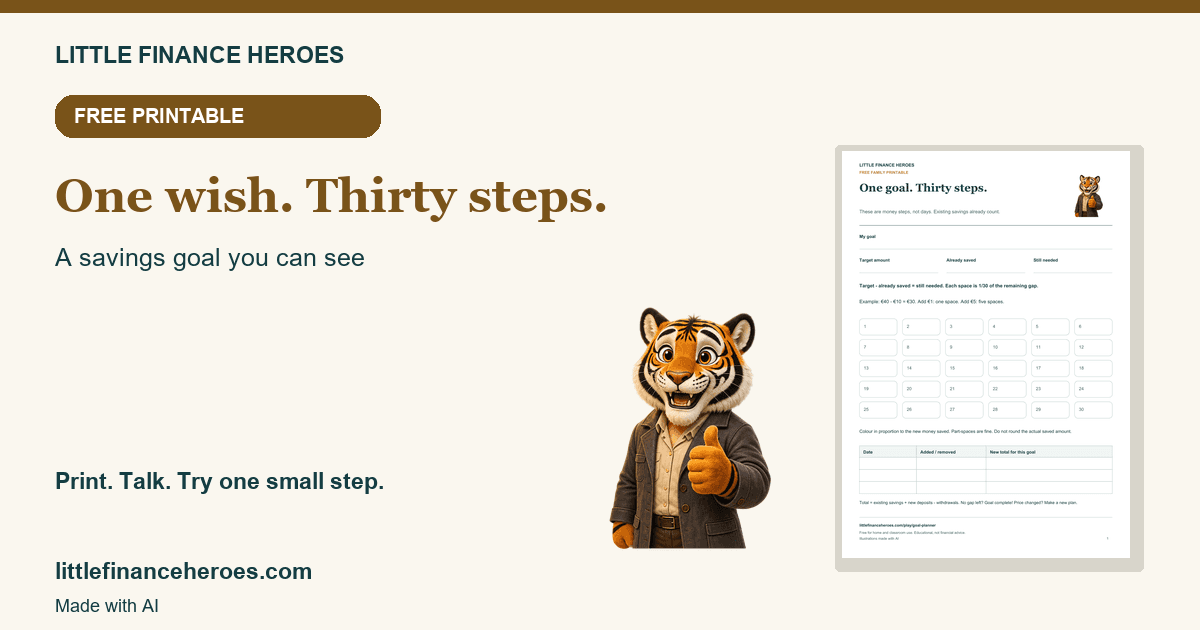
📄 Download the free tracker:choose one goal and colour thirty steps as you actually save.
A big wish can be hard to picture. Thirty empty spaces make it easier to point to the next small step. This free kids savings goal tracker from Little Finance Heroes keeps the focus on one goal and the money actually saved. Tally cheers on progress without asking for a perfect streak. The thirty spaces are money steps, not thirty days and not a promise that a wish will be paid for in a month.
Choose one goal worth waiting for
Ask your child what they want to work towards and why. Find a realistic target amount together, including any known costs needed to use the item. You do not need a shop visit to start: a fictional classroom goal works too. Rabobank describes a child-friendly spaartracker activity using a named goal, its cost and coloured progress. This LFH version provides a ready-to-print thirty-step layout and its own recording method.
Count what is already saved
Write the target at the top of the page, then record the amount already set aside for that goal. Subtract it to find what is still needed. The thirty new spaces represent that remaining gap, not the full target again. Keep existing money visible in its own box so it is not forgotten or counted twice. If nothing more is needed, there is no new gap to divide; mark the goal complete.
Give each space a clear meaning
Divide the remaining amount by thirty. Each space represents one thirtieth of that gap. For an easy invented example, a €40 target with €10 already saved leaves €30. Every €1 added after the start fills one space. A €5 contribution fills five. Existing savings plus that new contribution would total €15 towards the €40 goal. The example is arithmetic practice, not a current product price or a recommended savings amount.
What if the division is awkward?
Use the exact proportion rather than rounding every space upwards or downwards. Colour the part of the grid that matches the new money saved divided by the starting gap. An adult can help with a calculator. Keep the actual amount in the deposit log, even if a part-space remains uncoloured. Never invent another deposit just to finish a box. The written total is the record; the grid is a picture of it.
Make a plan that can change
Choose a weekly contribution that leaves room for other agreed choices. If a week is missed, write what really happened and continue. If the child spends some of the goal money, update the total and shading honestly. If the target price changes, make a revised plan rather than pretending the old grid still fits. You can print a new page and carry forward the amount already saved. No progress needs to be treated as a moral score.
Connect the paper and the tool
The free Goal Planner lets you organise the target, saved amount and weekly plan. Its weekly tracker and this paper money-step grid use different units, so do not assume one coloured space equals one week. Parents who want their own wider overview can separately explore the Money Dashboard. That is an adult planning tool, not a required account for a child's printable or an investment recommendation.
Keep the conversation small
At a check-in, ask what changed and what the next manageable step could be. In class, use fictional goals and equal starting amounts, not a comparison of family resources. Put the sheet somewhere private enough for your child to feel comfortable. Celebrate a thoughtful choice as well as the finish. The PDF is free and contains no pages from a paid workbook. It is educational, not financial advice. Illustrations made with AI.